
In Italian, they call it discovering hot water. In Hungarian, it’s inventing sealing wax. In Estonia we call it Inventing bicycle.
And I often wonder—what’s the Estonian version of that feeling, when something you’ve believed and practiced for years suddenly becomes “breaking news”?
That’s exactly what many of us at Belbin have felt recently.
Leading consultancies like McKinsey and Harvard Business Review have started publishing insights on team effectiveness—insights that reflect principles we’ve been living, applying, and refining through the Belbin Team Roles model for over 50 years.
“When teams get healthier, the whole organisation benefits.”
— McKinsey, 2023
Their latest work revisits a timeless question: Why do some teams succeed while others fail?
It’s a great question—and one that Dr. Meredith Belbin began answering scientifically as far back as the 1970s.
Let’s look at what McKinsey’s research says, how it mirrors Belbin’s work, and why these insights matter more than ever for those of us working with real teams in complex environments.
The ‘Top Talent’ Myth – And the Apollo Syndrome
McKinsey starts by challenging a myth that still lingers in many boardrooms:
“The best teams are made up of the most talented individuals in every seat.”
But experience—and evidence—tell a different story.
Dr. Belbin tested this idea decades ago in his now-famous research. His team created what they called Apollo Teams—groups of highly intelligent, academically gifted individuals.
The expectation? These teams would outperform all others.
The reality? They often finished last.
Here’s what went wrong:
- Endless arguments and overanalysis
- A focus on proving individual points rather than reaching consensus
- Blame culture and low trust
- Inability to commit to decisions
It wasn’t that the individuals weren’t brilliant—they were. But without collaborative behavior, team synergy failed to emerge.
This is now known as the Apollo Syndrome.
“It seemed fairly obvious,” wrote Dr. Belbin, “that a team of clever people should win a game that placed an emphasis on cleverness. But the Apollo team generally finished last.”
What matters is not how many stars are in the room, but how they interact.
That’s where behavioral diversity, trust, and role clarity come into play.
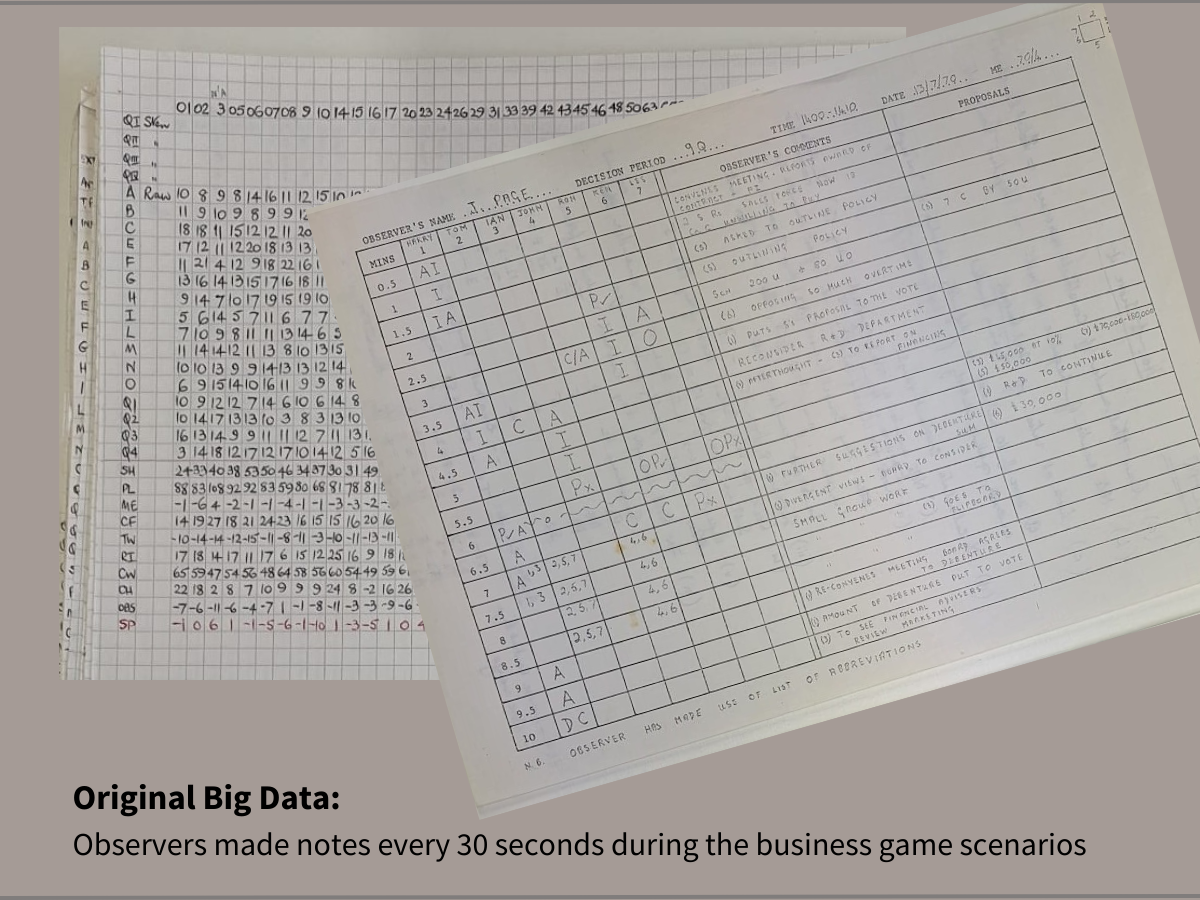
Original Big Data by Dr. Meredith Belbin
What Actually Drives Team Effectiveness?
McKinsey identified four key drivers that consistently separate high-performing teams from the rest:
- Trust
- Communication
- Innovative Thinking
- Decision-Making
These aren’t surface-level behaviors—they reflect deeper team dynamics and collective capability. According to McKinsey, these four factors alone explain up to 76% of the variance in team performance across efficiency, innovation, and outcomes.
Let’s explore each briefly, through the Belbin lens:
- Trust and Communication are built when people understand and value each other’s behavioral strengths. Belbin enables this by providing a shared language and feedback-rich profile that clarifies who brings what to the team.
- Decision-Making becomes more effective when Monitor Evaluators are heard, Coordinators seek consensus, and Teamworkers create harmony. Teams without these dynamics can struggle to act—or act too soon.
- Innovation flourishes when Plants and Resource Investigators are supported and allowed space to generate and explore ideas, without being shut down too early.
In short: Belbin doesn’t replace team development. It enhances it by helping us see what we otherwise miss.
Blind Spots: What Teams Often Overlook
McKinsey adds a powerful insight: most teams don’t know what they don’t know.
“Teams are often unaware of their most important gaps and can have shared blind spots.”
These blind spots aren’t always technical or strategic—they’re often behavioral or relational.
For example:
- A team might mistake busyness for collaboration.
- Or assume harmony is trust, when in fact tough conversations are being avoided.
- Or believe someone’s detailed critiques are negative, when they’re actually the Monitor Evaluator doing their job well.
This is why Belbin’s use of observer feedback is so crucial. It brings reality to the table—not just self-perception.
Seeing the Whole Picture with the Team Role Circle
One powerful Belbin tool—the Team Role Circle—gives teams a visual of their strengths, gaps, and overlaps.
It helps answer:
- Are we over-relying on a few roles?
- Is anyone being expected to act outside their natural strengths?
- What do we not have enough of—and what could that cost us?
With this information, teams can:
- Make smarter hiring or collaboration decisions
- Adapt role expectations
- Build awareness and support around ‘allowed weaknesses’
A team full of Implementers might execute flawlessly but lack fresh thinking. A team of Monitor Evaluators may endlessly discuss but never decide.
The key is balance, awareness, and open conversation.
Moving From Insight to Action
McKinsey warns that even with the right insights, teams often pick the wrong priorities to focus on—or try to improve areas where they’re already strong.
This is where team coaching makes the difference.
Team coaching helps teams:
- Interpret what their Belbin profile is really telling them
- Align on what needs attention first
- Use strengths consciously and strategically
- Establish working agreements that last beyond the session
It’s not about fixing people. It’s about raising awareness and reshaping how the team functions as a unit.
Final Reflection
McKinsey’s findings are valuable, timely, and well-researched.
But for many of us working with Belbin over the years, they sound very familiar.
That’s not a criticism. In fact, it’s encouraging. It shows that the core truths we’ve seen in teams for decades—truths rooted in behavior, balance, and real feedback—are finally getting the global spotlight they deserve.
So yes, maybe we are just discovering hot water again.
But maybe it’s time to pour that water into something that helps teams truly grow.
Adapted from the original article by Victoria Brown, Head of Research and Development at Belbin UK. Rewritten and published with permission, reflecting my own experience in team coaching.
Original McKinsey & Company article, “Go, teams: When teams get healthier, the whole organization benefits” (published October 31, 2024).